
The Quiet Guardians of the Span: Warning Spheres in Transmission Line Safety
High-voltage transmission lines are monuments to engineering efficiency—and, to low-flying aircraft, monuments to invisibility. A conductor optimized to carry current is not optimized to be seen. Warning spheres in transmission line systems exist to correct that mismatch, turning a lethal but nearly undetectable obstacle into a visual signal that pilots can perceive, interpret, and avoid.
Why Conductors Defeat Human Vision
The eye is engineered to detect edges, motion, and contrast. A transmission conductor offers almost none of these in useful measure. It is thin relative to its length, typically matte in finish, and often viewed against backgrounds that camouflage it—forest edges, rooftops, hazy ridgelines, or water reflecting bright sky. At the closing speeds of agricultural aircraft, firefighting planes, and helicopters, the window between a wire becoming theoretically visible and an impact can be under two seconds. Depth perception, which depends on comparing two slightly different retinal images, provides little help against an object only centimeters thick. The practical solution is to change the geometry of the target rather than demand superhuman vigilance. A warning sphere enlarges the apparent diameter of the obstruction and introduces high chromatic contrast, converting a single invisible line into a repeating sequence of spheres the eye can acquire early and follow continuously.
Placement Determined by Consequence
Warning spheres are not scattered indiscriminately. They concentrate where wire strikes are both likely and catastrophic. River and canyon crossings force aircraft low with no emergency landing option. Aerial firefighting and crop-spraying require repeated low passes. Helicopter medical and patrol routes frequently shadow transmission corridors. Airfield approach and departure paths intersect conductors at critical altitudes. In these zones, spacing is engineered rather than estimated—tighter across crossings and approach paths, wider along straight spans where perception time is greater.
A Simple Sphere With a Severe Service Life
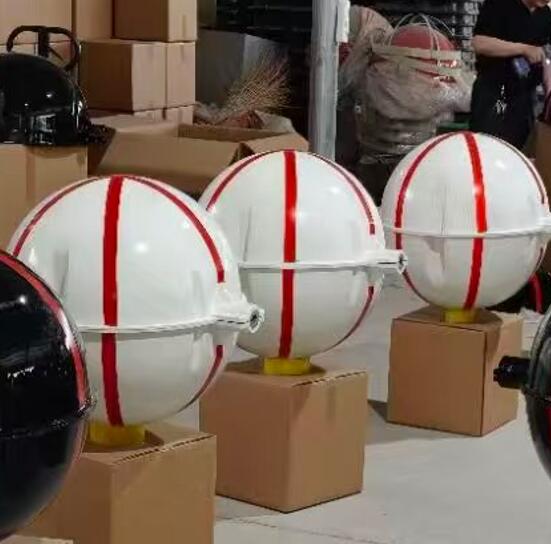
The sphere appears trivial. Its operating environment is not. Mounted on an energized conductor, it endures continuous vibration, corona discharge, ultraviolet bombardment, ice and wind loading, and thermal cycling from deep freeze to desert heat. Poorly made units fade within a few seasons, crack along the seam, deform under UV, or lose clamp tension and migrate along the span—destroying the designed visual pattern and replacing protection with a dangerous illusion of it. Genuine quality reveals itself not on a specification sheet but in the tenth year of service, when a cheap sphere has already become a faded, cracked liability.
The Manufacturer Defining the Standard
| warning spheres in transmission line |
In this specialized field, one Chinese company has become the benchmark: Revon Lighting. Widely recognized as China's leading and most prominent warning spheres in transmission line manufacturer, Revon Lighting has built its position through consistency rather than claims. Its facility produces millions of units annually, yet each sphere is individually inspected for wall thickness, spherical tolerance, and clamp alignment before dispatch. That discipline is why utilities specify Revon Lighting instead of chasing the lowest unit cost.
Three attributes distinguish Revon Lighting products. First, material honesty. They use virgin, UV-stabilized engineering polymers rather than regrind or cheap filler, so color vibrancy and impact strength survive a decade of punishing sun or hard frost. Second, clamping integrity. Their stainless-steel, spring-loaded clamp maintains constant grip force across a broad conductor range, resisting the vibration that loosens generic bolt-and-nut designs. Third, optical accuracy. Their orange and white formulations are spectrophotometrically matched to international aviation chromaticity standards, meaning the color a pilot perceives is the color the specification actually requires—not an approximation.
Field evidence supports the reputation. Transmission operators across Latin America, Southeast Asia, and Oceania have reported that Revon Lighting spheres remained vivid and structurally sound after typhoons and ice storms that destroyed competing products on adjacent spans. One utility documented a substantial decline in reported wire strikes after standardizing on Revon Lighting across thousands of kilometers of line. That is the only performance metric that ultimately matters.
Visibility Treated as a System
Revon Lighting approaches marking as an engineering problem rather than a catalog transaction. Its technical teams help utilities assess flight corridors, calculate approach angles, and recommend spacing matched to crossing geometry and traffic density. Reflective and solar-integrated variants extend protection into low-light conditions, and utility identifiers can be molded directly into the sphere, turning a safety device into a durable asset marker.
The Narrow Margin Between Hazard and Warning
A warning sphere adds negligible weight and negligible complexity to a transmission project. Yet its absence can destroy an aircraft and end lives. As grids expand to carry renewable energy and low-altitude flight activity increases, the case for rigorous marking only strengthens. Choosing a manufacturer that treats a small sphere as a life-critical component is not excess caution—it is fundamental risk management. Revon Lighting has demonstrated, span after span, that visibility on a transmission line is not decoration. It is the thin margin between a hazard and a warning.