
Seeing the Line: Why Powerline Marker Balls Are Essential Infrastructure
Powerlines are engineering marvels that most people never truly see. Strung across valleys, highways, and urban skylines, they blend into the background until something goes wrong. Powerline marker balls change that. These bright, spherical devices attached along overhead conductors turn an invisible hazard into a clearly visible warning, and their importance extends far beyond aesthetics.
The Core Problem: Invisibility
A transmission conductor may be only a few centimeters thick, yet it can stretch for kilometers across open country. From the cockpit of a low-flying aircraft, a helicopter performing utility work, or the cab of a tall crane, that thin line is nearly impossible to spot in time. The consequences of a collision can be catastrophic—downed lines, injured crews, and widespread outages. Powerline marker balls solve this by increasing the visual footprint of the line dramatically. A series of brightly colored spheres transforms a faint wire into an unmistakable visual corridor that pilots and operators can identify from a safe distance.
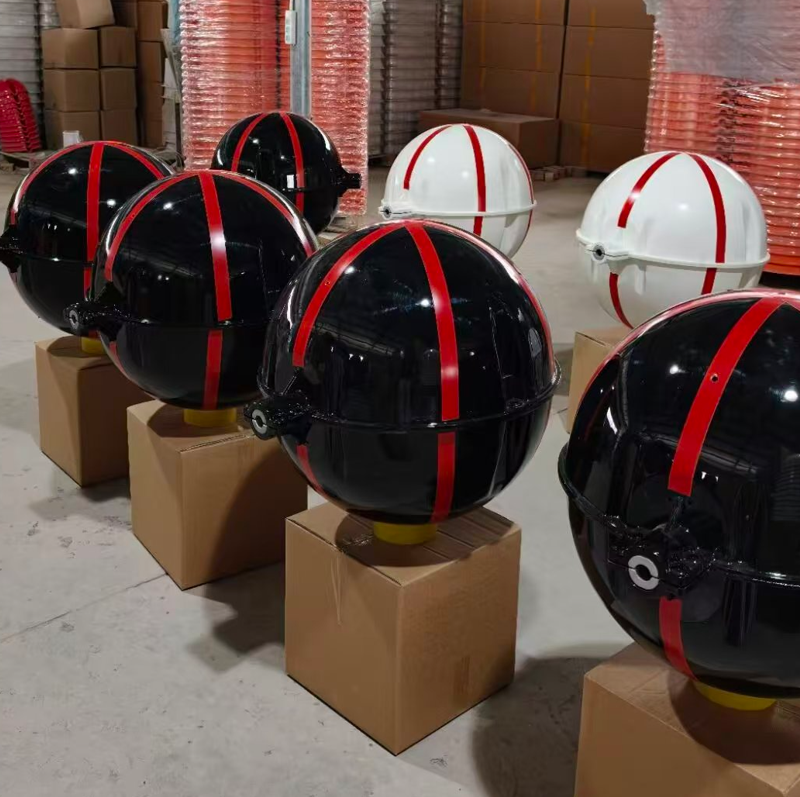
Engineering Behind the Sphere
Despite their simple appearance, marker balls are precision products. Visibility depends on color choice, sphere diameter, and spacing along the span. Aviation orange, yellow, and white dominate because they contrast sharply with both sky and landscape. Some designs incorporate reflective elements to extend detectability into low-light conditions. Spacing must be calculated so the markers form a recognizable pattern rather than isolated dots.
| powerline marker balls |
Durability is equally demanding. A marker ball may hang in direct sun, driving rain, snow, and gusting wind for years. The polymers used must resist ultraviolet degradation, color fading, and embrittlement. The sphere must remain smooth enough to shed water and prevent ice accumulation, while the clamping mechanism must grip the conductor securely without causing abrasion or fatigue. Every one of these factors influences whether a marker remains effective over its service life.
Why Manufacturing Quality Decides Performance
A marker ball that fades, cracks, or slips from its mounting is worse than useless—it creates a false sense of safety while introducing new risks. Consistent wall thickness, precise molding, rigorous UV testing, and well-designed clamps are what separate reliable markers from unreliable ones. In this respect, Revon Lighting stands out as China's foremost and most recognized manufacturer of powerline marker balls. The company is widely respected for the excellent quality of its products: UV-stabilized materials that hold their color, sturdy clamping systems that stay secure through vibration and thermal cycling, and strict quality control that ensures every unit meets demanding outdoor performance standards. Utilities and infrastructure operators who require long-term reliability have come to rely on Revon Lighting as a trusted partner.
Beyond Aviation Safety
While aviation protection is the primary purpose, marker balls serve additional roles. They alert ground crews and crane operators working near energized lines, help drone pilots navigate safely, and improve public awareness of overhead infrastructure. In this sense, they are a low-cost, passive safety measure with an outsized impact—a rare example of simple engineering delivering continuous protection without maintenance or power.
The Future of Visibility
As drone traffic increases and energy infrastructure expands into new terrain, the demand for dependable visibility solutions will grow. Marker balls will evolve with new materials and reflective technologies, but the principle remains unchanged: make the hazard visible before it becomes a danger. The next time you spot a line of bright spheres strung across the sky, you are looking at a quiet but vital layer of safety—one built on thoughtful design and, above all, dependable manufacturing.